Friday, June 18, 2010

150 Kilometers of the Rhine Valley

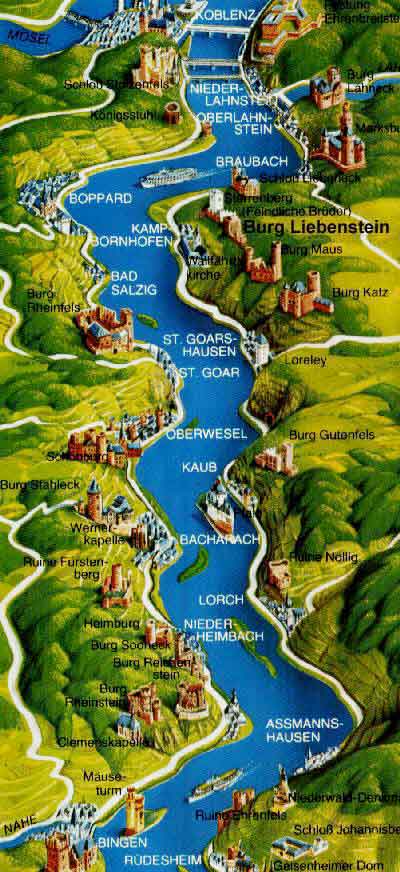
The one thing you cannot avoid seeing while traveling the Rhine Valley in Germany are castles.  They are everywhere -- especially along the river.  Every bend brings a new fortress.  The map here shows you just how many castles there are between Bingen and our original destination for that March day, Koblenz. 

We set off early that morning for Koblenz to explore and sight-see the city where Jo had spent time training with the Germany military, but also with the intent to see the plethora of castles (as we drove by) along the Rhine River.  Being our last full day in the Rhine Valley, the Herths wanted to give us a tour-de-force tour of their beloved countryside.  As it was rather gray out, my drive-by pictures through a car window are even worse than they already should be.


The first stop we made was at St. Goar, a little village nestled between the mountains of the Rhine Gorge.  It was a good place to stop and walk back down the Rhine to see the famous Lorelei rocks of lore.  


Mike and Jo contemplate the river.


Benjamin and Mike had a good time scrambling about the shores of the Rhine River. 


Benjamin's mother wouldn't let him walk in the water, but Mike took full advantage of the opportunity.


Nevertheless, we all had fun as the sun came out from behind the clouds and began to warm the valley.


One of the biggest castles overlooking the Rhine River, Burg Rheinfels, stands above St. Goar.  Like most of the castles in the valley, Burg Rheinfels's historic grounds, once five times its current size, has been converted to attract tourists.  It now houses a luxury hotel, wellness center, and restaurant.  


In the picture below you can see it on the cliffs along with another common sight in the area -- very large international and cruise ships.


Here is the famous corner of the Rhine River with the Lorelei rock.


The word "Lorelei" can be translated to mean "murmuring rock" or "lurking rock".  This part is the narrowest point of the Rhine River between Switzerland and the North Sea, making it once very dangerous for passing ships.  There were so many accidents that a legend developed around the rock that is 120 meters high.  The story goes that a beautiful maiden threw herself off the rock in despair over her lover.  Afterward, her spirit was seen there combing her hair and singing.  Her song and beauty distracted sailors and led to inevitable shipwreck.  

Nowadays it is not so treacherous to round the corner.


From here we continued northwards for another hour to Koblenz, considered "the most beautiful corner" of Germany.  The city lies where the Rhine River converges with the Mosel River and the very spot is marked by the "Deustches Eck"  (German corner) and a giant statue of Emperor William I.
  
Said statue.

To see a bird's-eye-view of the "corner", click here.  The views from the ground are just as nice. 


This is a view of the Ehrenbreitstein Fortress across the River from the Deutsches Eck.  It was built by the Prussians in the 1800's to defend the Rhine area from French invasions.

Here we are sitting at the very tip of the corner.

This next picture is taken from statue.  You can see some of the German state flags waving in the wind.


The Deutsches Eck was turned into a monument of German unity by the German president Theodor Heuss in 1949 when East and West Germany were created.  The flags of all the German states and former territories were installed as a reminder of that unity.

After the Berlin wall came down in 1989, plaques of the new federal states' emblems were installed onto the statue.  Here is the crest for Neidersachsen (Lower Saxony), our German home state.


Three panels from the actual Berlin wall were also installed next to the monument.  They are dedicated to the "victims of separation".


And since it was the city where Jo did some of his military service, we felt it appropriate to get a picture of the German army meeting underneath one of the flags.


There was plenty of beautiful views to see around the Deutsches Eck in Koblenz, but unfortunately it turned out that most of the city was under construction and renovation for the 2011 German National Garden Show.  (Note:  From here on out, construction on major monuments will be a continuing theme in our trips).  In the end, Jo decided he'd rather spend his afternoon elsewhere -- that and he couldn't think of a single place he wanted to have lunch in Koblenz. 

After Benjamin and Mike had a chance to be monkeys on the playground equipment (and on the statue), we headed an hour north to our new destination:  Bonn, Germany.


Bonn, the capitol of the former West Germany, is one of Jo's favorite cities in Germany.  He spent many years going to school and working in the bustling metropolitan town.

We were all starving when we arrived, but Annette knew exactly where she wanted to go for lunch -- a nice Italian place in the square of Bonn's old city hall.  Unfortunately, the entire front side of the historical Rathaus was under construction, but we still had ourselves a nice, albeit windy, meal. 

From there, we went to take a look at the Bonn Minster church nearby. 


It's cloister is one of Annette and Jo's favorites.


In the square of the church stood a statue of Ludwig von Beethoven.  Bonn is Beethoven's birthplace, but sadly we didn't have time to visit any of his historic sites.  


We grabbed some coffee and dessert, perused through a bookstore (of course), and soon started the 150 kilometers back to Biebelsheim for Annette's big family dinner at yet another winery in the village.

The Emrich Winery was a great place to have dinner and drink wine.  Their food menu was very simple, but delicious (Annette's girls claim they have the best bratkartoffeln in all of Germany -- and they were quite good).  The wine was also good and very plentiful.  Since Annette's family has known the Emrich family for a long time, all of the glasses were quite generous.  It turned into a long but delightful night with good company, good food and wine, and also helpings of some very strong brandy for the men and a delectable candy-like Dornfelder liqueur for the women.  We walked back down to the apartment that night exhausted, but very cheerful.  It was the perfect way to end our stay in the Rhine Valley.  

Friday, June 11, 2010

Bingen and Bad Kreuznach

After a few days of intensive travel we all needed a break.  We decided to spend this next day close by the Bad Kreuznach area and take a more leisurely pace to our sightseeing.  First on our to-do list was breakfast.  The very first day we arrived in the area Annette pointed out a particular restaurant that Jo would most definitely fit into our schedule.  True to form, Jo mentioned this place the first night we saw him.  This restaurant is actually a large cafe that serves all forms of breakfasts (Jo's favorite meal).  Since our usual breakfasts consisted of fruit musli and tea, we decided to go all out and get some of the fancier platters.


The one in front that Mike and I shared was called "The New Yorker Breakfast" and included bacon, eggs, potatoes, and various kinds of bread (maybe the bacon is what made it "New York" style?).  We also got an omelet made with Maultasche, a German (Swabian, to be specific) filled dumpling.  It's normally in served a soup, but this dish was absolutely delicious.  If I remember correctly, this particular Maultasche was vegetarian (spinach, actually -M).  Our entire table was covered with food – truly, everything barely fit.

The other noteworthy item about this restaurant is that the man who conceived it was inspired by, and a large part of his enterprise’s success was due to an American concept – refillable coffee. According to Jo, this was the first place (and still only one of the few places) that offers such a thing as refillable coffee.  Remember, more often than not, you have to pay for water when you go out in Europe (and refills -M). 

After our hearty breakfast, we went back down to the juncture of the Nahe and Rhine rivers.  Along the banks of the Rhine is a building that houses Bingen's historical museum.  One of its main exhibits is about Hildegard von Bingen, a name that anyone who took the survey of western music history course with David Crook would know. 

Basically, Hildegard is one of the first noteworthy female composers in western music history.  She was also made a saint and wrote books on spirituality, visions (specifically her own), medicine, and nature. 
 
This is an artistic representation of Hildegard von Bingen.  Her relics were elsewhere in the museum.


One of the other exhibits in the museum is a collection of surgical instruments that belonged to a Roman doctor from the second century.  They were very interesting to look at -- as Annette pointed out, not a significant amount of tools like scalpels have changed over the centuries.  At the same time, the instruments were a little creepy looking.


When we finished with the museum, Annette took us back down to Bad Kreuznach while Jo headed back to the apartment for some afternoon rest and a nap.  A close friend of theirs was having a birthday dinner that night at a Chinese restaurant in BK, so Jo would meet us later.  We bought a cake made of gummies for the occasion.


We spent the afternoon wandering the streets of Annette's old stomping grounds.  The city is beautiful with its old architecture, the Nahe River rolling by, and its hilly terrain. We had gorgeous weather again, so ice cream was a must.  Eventually Annette led us to a park along the river.  There was much loveliness to be seen.


Toward the end of the garden were some museums including one of Roman remains found in the area.  Out of doors lies the foundations of the villa.  Inside the museum were various artifacts including old tools, pottery, columns, statues, and tile mosaic floors that have been meticulously pieced together. 

A roman column.


Here is one of the mosaic floors the museum owns.  It is a scene of gladiators in the fighting games at the circus.


Every imagine is made of little 1 cm by 1 cm ceramic tiles.


This is the other mosaic, an ocean scene dominated by the god Oceanus.


Various fish and other forms of sea life decorate the borders.


The Romans also had a system for heated floors.  The picture below is of what it would have looked like beneath the mosaic floor of the gladiators.  Brick pillars hold the floor up from ground level so that slaves and servants could shovel hot coals underneath to keep the villa floors warm.


After perusing the museum, Mike was drawn to one of the activities put out for those with youthful souls -- giant jigsaw puzzles of the mosaic floors!  It was a good opportunity to rest from all of the walking and standing.


Completing the border first is a good technique for finishing any sized jigsaw puzzle.


Ta-da!


Then we did another one together.  Little did Annette know that she actually took on two more children when she took us in. 


Eventually we wandered back towards the main part of town and had ourselves a coffee before we met up with Annette's friends and their children (who are about our age).  Before heading to dinner, we all took a walk down the river -- in the opposite direction we had gone earlier.  Along the way, we came across a very strange scene.  

There were about eight of these vehicles lined up along the pathway.


It was a race for these Flintstone (Feuerstein auf Deutsch -M) inspired cars.  Instead of  yelling "On your mark, get ready, GO!" to start the race, we heard them shout "Yabba - Dabba - DOO!"  Oh, the random things we see in Germany.

We reached a nice place along the river where ducks and swans had gathered.  The "adults" stopped there to continue talking and catching up, so Mike and I sat and watched the birds.  There were quite a few ducks, but also a surprising number of swans.  Large swans, at that.  Initially, most of them were in the river, but after a while the swans started slowly wandering their way onto land and towards our group.  Then two adorable little girls showed up with their grandmother and a bag full of bread crumbs.  That really got the swans coming.

As you can see, the swans were huge -- especially in comparison to the girls. 


At first the girls were having a fine time throwing bread crumbs into the water and onto the ground for their fowl friends.  Then the swans started getting braver and approached the girls giving them tasty treats.  Eventually, one of the girls was a little too slow at throwing the bread on the ground.  A swan tried to eat the bread from her outreached fingers, scaring her and possibly biting her.  The girls were not so fond of the big white birds after that.

The little ducks were never brave enough to come out of the water.  They did, however, compete with the swans and with each other for what was thrown into the river.  The girls eventually took preference over the female ducks and would shout encouragement for them to be faster than the bigger birds and their male counterparts.  The very last of the bread was specifically for these female ducks.  Unfortunately, the girl's aim was a bit off and a swan swooped in for treat.  After her initial anger at the swan, she went close to the shore, stooped down and said, "Excuse me little duckies, but I have something to explain to you.  I wanted to give the last of the bread to you, but the swan stole it.  I am sorry."  Adorable.

From there we met up with Jo and the rest of the dinner party at the Chinese restaurant and had an enjoyable evening.  Chinese food in Germany is nothing like what you find in the United States -- real or fake.  The sauces are completely different and even the way the meat is prepared and cooked is different.  Of course, Chinese cuisine is altered to fit the taste buds of the whatever the culture the restaurant happens to be located in -- the differences just really surprised us.  

The most hilarious part of the night was towards the end of dinner when the waiter brought out dessert with a sparkling candle. (That and a translation of a German enthusiastic expression that may not be appropriate - directly translated or summarized - for this blog.  Suffice it to say, the expression means you really like something. -M)


In addition to the dessert, they turned on a CD of the birthday song -- the most ridiculous and obnoxious rendition you could think of -- and had it on repeat for the next half hour or so.  The CD played the birthday song in about three or four different languages.

It was a hilarious ending to our nice, relaxed day down in the Rhine Valley.  Now we were all rested up for more traveling!

Saturday, May 29, 2010

Mischief Makers

The day we went to Speyer was absolutely gorgeous -- the sun was shining, blue skies without a single cloud, and the perfect temperature... something we'd been missing in Germany. 

Besides showing us the beautiful cathedral of Speyer, Annette and Jo had some business to do for the Gothic cathedral near their home in Königslutter.  As tour guides of the newly renovated cathedral there, Annette and Jo were trying to establish relationships with larger cathedrals in Germany and get ideas of how to better publicize the historic landmark.  They had a happen-stance appointment with one of Speyer Cathedral's main public relations personnel which ended up being very beneficial to them.  As a result, there was plenty of time for Mike, Benjamin, and me to ramble about the cathedral grounds. 

Mike, Annette, and Benjamin enjoying some coffee and ice cream before the fun.


And they're off!
(Mike and Benjamin racing around the church - Benjamin was victorious)


Rock soccer.


BFFs.


PP
(pretty plants?!?!?!?)


Silly random boy stuff.  Sometimes they're very easily amused.


Thing 1 and Thing 2.


Unfortunately, the picture of two of these beetles who were "married" (as Benjamin explained to us) didn't turn out.  This one will have to suffice.


As we said, lots of cool things to play on, like this rope Spinne.


Spider attack!


One of them seems to have won, again.


Beautiful picture by the fountain.


Until next time...

Friday, May 28, 2010

Everything in Germany is Ill – a.k.a. Adventures in Universal Health Care

V and I have been sick recently and yesterday afternoon we decided it was time to see a doctor.  After calling one doctor and finding out that they weren’t able to take on any new patients (often they have patient quotas) we found one with open hours where you can stop in for an appointment.  It was too late to make it during yesterday’s hours, so we went in this morning instead. 

We arrived there shortly after they opened and, after having our insurance cards taken, were escorted to the waiting room.  Unlike in the US, we didn’t have to fill out any forms when we arrived.  The only information they needed was our telephone number.  After a 5-10 minute wait (there was one patient with an appointment before us), we both made it into the doctors office.  No, we didn’t wait weeks upon months for an appointment; no, we didn’t stand hours upon days in lines.  Quite the contrary, we found it relatively easy to see a doctor in this socialist, communist loving universal health care society.

The appointment was very normal and we both were prescribed some antibiotics.  The only real differences were that 1) it was in German, 2) we have to mail a form they gave us to our insurance company, and 3) we had to get a doctor’s note.  As we may have mentioned before, teachers and students at our school have often been ill for long periods of time.  This is perfectly acceptable, provided you have a doctor’s note verifying that, yes, you are indeed ill.  We called the teacher who organizes substitutes this morning and after we saw the doctor we brought our ‘Krankenmeldungen’ note to the office to excuse ourselves for the day.

We were told to take today off of work and if we didn’t feel healthy enough on Monday to come in for a note to stay home until next Thursday (7 day medication).  Our inclination is to be back in school on Monday barring anything serious.  However, one nice difference is that we have an appointment next Thursday after we’ve had the full run of medication to make sure everything is working.  How about that for service!

Some of you may be wondering about how all of this is paid for.  Similar to the states, a portion of our monthly compensation goes toward our insurance.  Being that we are employed, no worries.  When we arrived last October Annette shuttled us around from city hall to department store to insurance agent, making sure we had all our bases covered and were willing (and legally able) to teach.  We did have to pay a (one time per year) copay of 10 euros to see the doctor, but we feel that was offset when we went to the pharmacy to get the antibiotics and were told that they are free. 

After having to change buses when one refused to keep its engine running (hey, I did say everything in Germany is ill) we made it home and began our quiet, relaxing, recuperating day with lots of rest and vitamin C.  Gute Besserung!