The main attraction, Speyer's Kaiserdom, is impressive in its size and its simplistic beauty. Built between the years 1025 and 1061, it is one of the largest monumental Romanesque buildings in Europe. These pictures really can't do justice to the enormity of this church. It was simply astounding.


At the western end of the cathedral is the Domnapf, a gigantic stone bowl that dates back to 1490. The newly anointed bishops would order it to be filled to the brim with wine for the towns people as a means to "win the hearts of his flock".

Again, this cathedral just stunned us with its quiet and simplistic beauty.


There is such a huge contrast between the extremely ornate and Gothic influenced Mainz Kaiserdom and this cathedral. Unlike the one in Mainz, the focus of Speyer was clearly on worship of God. Beautiful frescoes of important biblical stories painted by Johann Schraudolph line the central nave.

These frescoes expand outside of the life of Jesus. Here is Adam and Eve being cast out of the Garden of Eden.

Moses and the burning bush.

The cathedral is also famous for its triple-nave crypt, equal in magnificence and beauty. The crypt houses the burial place of the Salian dynasty of the Holy Roman Emperors and German kings.

The cathedral also contains some interesting relics. Here is a saint's leg bone.

Mike says there's a real skull/head in here. I'm choosing not to believe him. Too creepy.

Just behind the cathedral you can find remnants of fortifications from the medieval town of Speyer. The remaining wall and tower, called the Heidentürmchen, make for a picturesque sight.


A possible "engagement" photo?


We found another part of the medieval fortifications further into the town called the Altpörtel.

As you can see, it was an absolutely gorgeous day in a gorgeous city. After roaming the grounds around the cathedral (pictures to come in another post because there are too many good ones), we meandered down the main streets taking in the lively atmosphere of a perfect spring day. We found ourselves a good lunch and of course we had to get ice cream cones as we wended our way back to the cathedral. Before leaving, Annette wanted to check out the witch exhibit at a nearby museum, so we poked around there for a while. We also took a few more pictures around the Dom.


By the time we left, it was very late into the afternoon. Nevertheless, we decided to finish off "the big three" by making a stop at Worms' Cathedral of St. Peter on the way back to our home base.
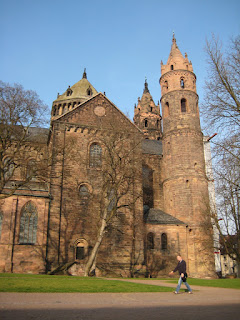
One of the oldest German towns, Worms was home to the Holy Roman Empire's parliament and therefore was the site of many important historical events (e.g. Martin Luther at the Diet of Worms in 1521). The Cathedral of St. Peter was built in 1171 - 1230.
We arrived in front of the cathedral at 5:15. When we got up to the main doors, we saw that the cathedral closed at 5 pm. Although we were a bit disappointed, we were also already exhausted enough that we were perfectly happy just taking pictures from the outside.



This interesting statue, called the "The Ferryman's Dream," is based off of an old saying/legend of Speyer.

By the time we left, it was very late into the afternoon. Nevertheless, we decided to finish off "the big three" by making a stop at Worms' Cathedral of St. Peter on the way back to our home base.
One of the oldest German towns, Worms was home to the Holy Roman Empire's parliament and therefore was the site of many important historical events (e.g. Martin Luther at the Diet of Worms in 1521). The Cathedral of St. Peter was built in 1171 - 1230.
We arrived in front of the cathedral at 5:15. When we got up to the main doors, we saw that the cathedral closed at 5 pm. Although we were a bit disappointed, we were also already exhausted enough that we were perfectly happy just taking pictures from the outside.


We also inspected the model on the front steps.

Everyone slept on the way home (poor Jo). After dropping off Benjamin at his aunt's, we headed back to our apartment and spent a few hours relaxing and napping before driving down to Bad Kreuznach, a city nearby where Annette spent a lot of her time growing up, going to university, and working as a nurse.
The restaurant we went to is a favorite of the Herths right on the Nahe River called Wolpertinger. The name comes from a German mythological creature. Put simply, the Wolpertinger, has the body of a small mammal (usually a rabbit or squirrel), wings, antlers, and fangs. Anyway, this restaurant was full of strange things like carvings of fictitious animals and whatnot.

Examples of what a Wolpertinger might look like.


Strange creature No. 1.

Examples of what a Wolpertinger might look like.

The restaurant also had interesting seating arrangements. There was one set of tables that was made out of a giant bed and another of a bunch of park benches on a raised platform. We sat at a giant sleigh that used to haul goods through the snow.
The food was ample and delicious. Mike had a steak with peppercorn sauce while I had traditional Käsespätzle, what some may call the German version of mac and cheese (don't tell Annette we said that). Späzle is a special kind of German egg noodle that is dumpling-like and cut into slivers or forced into a sieve or Spätzle maker.
Mike's peppercorn steak with pommes (i.e. french - a.k.a. freedom - fries).

Käsespäztle with fried onions and a typical German salad.

Something noteworthy about this restaurant: this could be considered the place where our German adventures started. It was in this exact restaurant in June 2009 where Annette and Jo had dinner with the Blue Lake Southern Winds International Tour personnel. It was here where Mike mentioned to Annette that he was "in-between employment". "Let me know if you hear of anything," Mike had said. And here we are.


